



DQPT in the Ising model
In this tutorial we will try to reproduce the results from this paper. The needed packages are
using MPSKit, MPSKitModels, TensorKitDynamical quantum phase transitions (DQPT in short) are signatures of equilibrium phase transitions in a dynamical quantity - the Loschmidt echo. This quantity is given by
In the mentioned paper they work with
and show that divergences occur when quenching across the critical point (g₀ → g₁) for
The outline of the tutorial is as follows. We will pick
First we construct the Hamiltonian in MPO form, and obtain the pre-quenched ground state:
L = 20
H₀ = transverse_field_ising(FiniteChain(L); g = -0.5)
ψ₀ = FiniteMPS(L, ℂ^2, ℂ^10)
ψ₀, _ = find_groundstate(ψ₀, H₀, DMRG(; verbosity = 0));
Finite MPS quenching
We can define a helper function that measures the loschmith echo
echo(ψ₀::FiniteMPS, ψₜ::FiniteMPS) = -2 * log(abs(dot(ψ₀, ψₜ))) / length(ψ₀)
@assert isapprox(echo(ψ₀, ψ₀), 0, atol = 1.0e-10)
We will initially use a two-site TDVP scheme to dynamically increase the bond dimension while time evolving, and later on switch to a faster one-site scheme. A single timestep can be done using
H₁ = transverse_field_ising(FiniteChain(L); g = -2.0)
ψₜ = deepcopy(ψ₀)
dt = 0.01
ψₜ, envs = timestep(ψₜ, H₁, 0, dt, TDVP2(; trscheme = truncrank(20)));
"envs" is a kind of cache object that keeps track of all environments in ψ. It is often advantageous to re-use the environment, so that MPSKit doesn't need to recalculate everything.
Putting it all together, we get
function finite_sim(L; dt = 0.05, finaltime = 5.0)
    ψ₀ = FiniteMPS(L, ℂ^2, ℂ^10)
    H₀ = transverse_field_ising(FiniteChain(L); g = -0.5)
    ψ₀, _ = find_groundstate(ψ₀, H₀, DMRG(; verbosity = 0))

    H₁ = transverse_field_ising(FiniteChain(L); g = -2.0)
    ψₜ = deepcopy(ψ₀)
    envs = environments(ψₜ, H₁, ψₜ)

    echos = [echo(ψₜ, ψ₀)]
    times = collect(0:dt:finaltime)

    for t in times[2:end]
        alg = t > 3 * dt ? TDVP() : TDVP2(; trscheme = truncrank(50))
        ψₜ, envs = timestep(ψₜ, H₁, 0, dt, alg, envs)
        push!(echos, echo(ψₜ, ψ₀))
    end

    return times, echos
end
finite_sim (generic function with 1 method)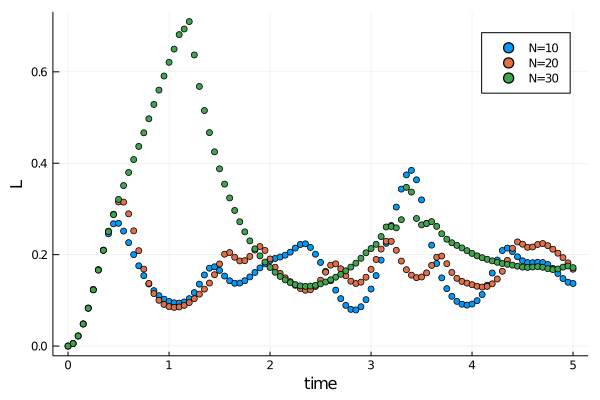
Infinite MPS quenching
Similarly we could start with an initial infinite state and find the pre-quench ground state:
ψ₀ = InfiniteMPS([ℂ^2], [ℂ^10])
H₀ = transverse_field_ising(; g = -0.5)
ψ₀, _ = find_groundstate(ψ₀, H₀, VUMPS(; verbosity = 0));
The dot product of two infinite matrix product states scales as
dot(ψ₀, ψ₀)1.0000000000000029 + 1.5212645660908792e-16imso the Loschmidt echo takes on the pleasant form
echo(ψ₀::InfiniteMPS, ψₜ::InfiniteMPS) = -2 * log(abs(dot(ψ₀, ψₜ)))
@assert isapprox(echo(ψ₀, ψ₀), 0, atol = 1.0e-10)
We make use of the changebonds machinery to grow the bond dimension. This can also be achieved through a two-site scheme. Multiple algorithms are available, but we will only focus on OptimalExpand(). Growing the bond dimension by
ψₜ = deepcopy(ψ₀)
H₁ = transverse_field_ising(; g = -2.0)
ψₜ, envs = changebonds(ψₜ, H₁, OptimalExpand(; trscheme = truncrank(5)));
a single timestep is easy
dt = 0.01
ψₜ, envs = timestep(ψₜ, H₁, 0, dt, TDVP(), envs);
With performance in mind we should once again try to re-use these "envs" cache objects. The final code is
function infinite_sim(dt = 0.05, finaltime = 5.0)
    ψ₀ = InfiniteMPS([ℂ^2], [ℂ^10])
    ψ₀, _ = find_groundstate(ψ₀, H₀, VUMPS(; verbosity = 0))

    ψₜ = deepcopy(ψ₀)
    envs = environments(ψₜ, H₁, ψₜ)

    echos = [echo(ψₜ, ψ₀)]
    times = collect(0:dt:finaltime)

    for t in times[2:end]
        if t < 50dt # if t is sufficiently small, we increase the bond dimension
            ψₜ, envs = changebonds(ψₜ, H₁, OptimalExpand(; trscheme = truncrank(1)), envs)
        end
        ψₜ, envs = timestep(ψₜ, H₁, 0, dt, TDVP(), envs)
        push!(echos, echo(ψₜ, ψ₀))
    end

    return times, echos
end
infinite_sim (generic function with 3 methods)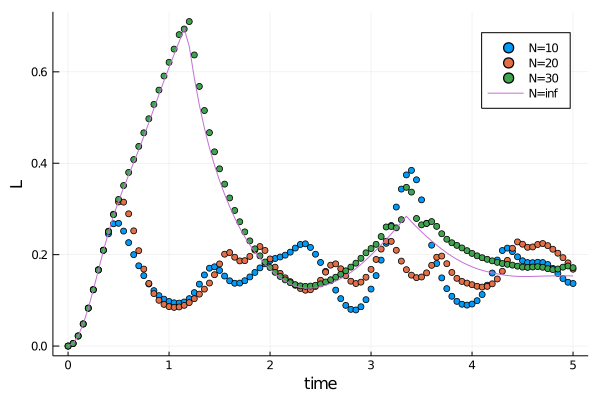
This page was generated using Literate.jl.