
Examples
This gallery collects the full worked examples that ship with MPSKit.jl. Each one is a complete, runnable script (also available as a Jupyter notebook, linked from the example page itself) that goes well beyond the short snippets in the how-to guides.
The examples are grouped by the kind of computation they demonstrate rather than by the physical system. Within each group they are listed roughly in order of increasing difficulty: start at the top if you are new to MPSKit, and work down as you get comfortable with symmetries, infinite systems, and the less common algorithms.
Ground states
The transverse-field Ising model: a complete ground-state study
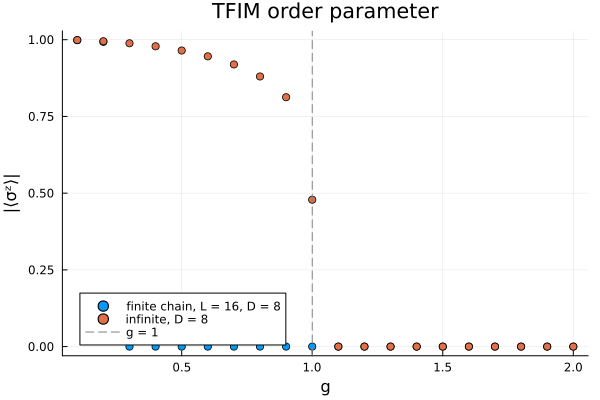
Assembles the tools from the tutorials into one case study of the TFIM phase transition: finite-ring DMRG versus infinite-chain VUMPS magnetization curves in a single figure, plus the entanglement entropy and correlation length of the infinite state across the transition. The natural first example after finishing the tutorial track. Level: introductory.
The XXZ model
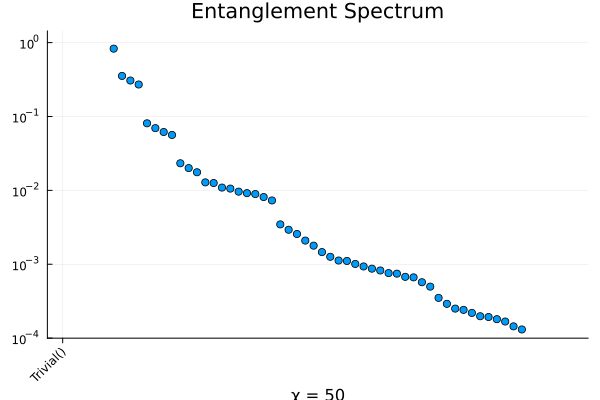
Walks through a ground-state search that first goes wrong: single-site VUMPS and GradientGrassmann stall on the spin-1/2 Heisenberg antiferromagnet, and transferplot/entanglementplot reveal a near-non-injective state with several almost-degenerate transfer-matrix eigenvalues. The fix is a two-site unit cell together with the SU2Irrep-symmetric Hamiltonian, after which IDMRG2 and VUMPS converge cleanly. A useful, diagnostic-driven example for recognizing and debugging convergence failures. Level: intermediate.
Hubbard chain at half filling
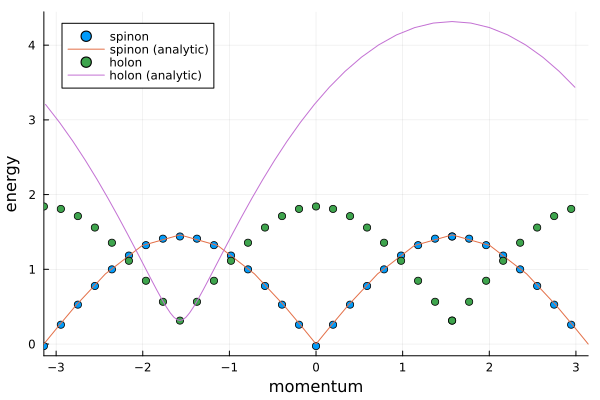
Studies the 1D Hubbard model at half filling with fermionic InfiniteMPS, first benchmarking a plain VUMPS/GradientGrassmann ground-state search against the exact Bethe-ansatz integral for the energy, then imposing the full particle-number and spin symmetry (U1Irrep, SU2Irrep, with MPSKit.add_physical_charge to pin the filling) and constructing the spinon/holon excitation spectrum with the QuasiparticleAnsatz. Combines fermionic symmetry sectors with a more elaborate ground-state recipe (staged bond-dimension growth via changebonds/OptimalExpand, SvdCut, and mixed VUMPS/GradientGrassmann refinement). Level: advanced.
1D Bose-Hubbard model
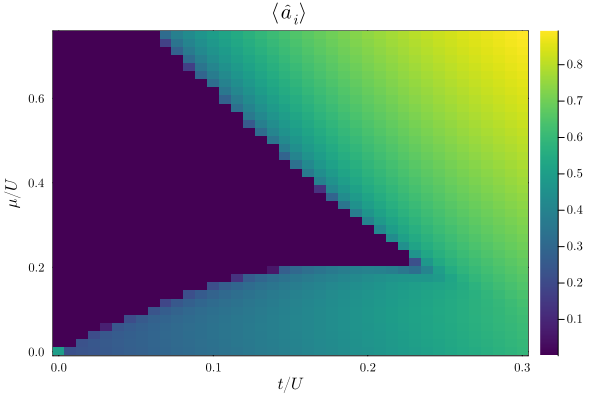
The most comprehensive ground-state example in the gallery: works directly in the thermodynamic limit with a truncated bosonic local Hilbert space, extracts correlation functions and the correlation length as a function of bond dimension, computes the momentum distribution, and maps out the Mott-insulator/superfluid structure of the phase diagram from the ground-state response to an applied phase twist. Touches most of the ground-state toolbox (InfiniteMPS, find_groundstate, bond-dimension control, expectation_value-based observables) in a single, longer study. Level: advanced.
Spin 1 Heisenberg model
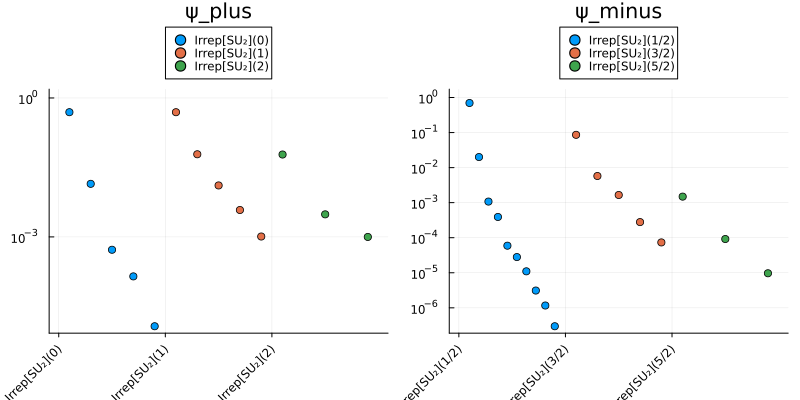
Distinguishes the two symmetry-protected topological phases of the SU(2)-symmetric spin-1 Heisenberg chain by restricting the virtual SU2Space to integer or half-integer charges, then compares the two resulting ground states through their energy, transfer-matrix spectrum (transferplot), entanglement spectrum (entanglementplot), and entanglement entropy (entropy). Builds directly on the symmetry machinery introduced in the Haldane gap example. Level: intermediate/advanced.
The Ising CFT spectrum
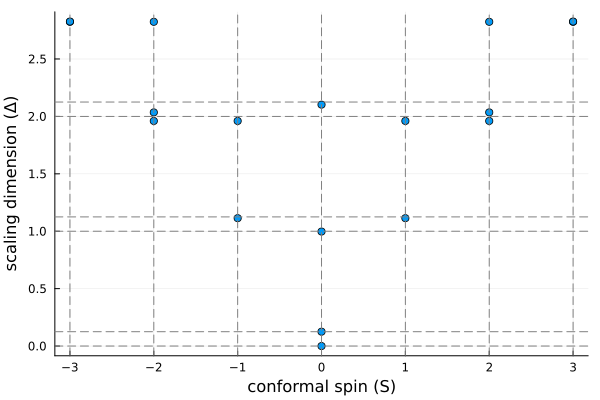
Extracts the finite-size conformal spectrum of the critical transverse-field Ising chain, first by brute-force exact_diagonalization on a small periodic chain, then by extending to larger sizes with finite DMRG and the QuasiparticleAnsatz, using a translation MPO to assign a momentum label to each state. No symmetries are used, which makes this a good entry point into the finite-MPS workflow. Level: introductory.
Excitations & dispersions
The Haldane gap
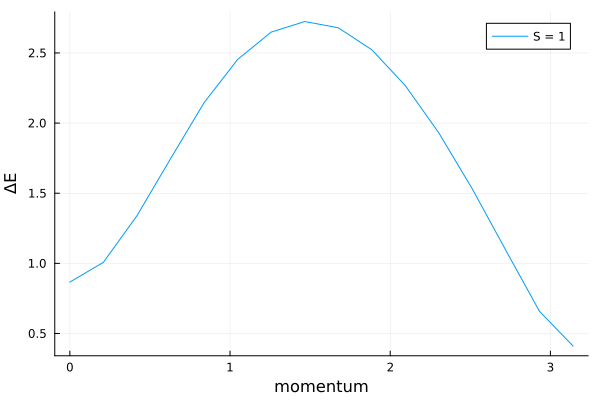
Computes the Haldane gap of the spin-1 Heisenberg antiferromagnet in two complementary ways: finite-size DMRG with the QuasiparticleAnsatz, extrapolated over system size, and a direct infinite-chain VUMPS calculation with a momentum-resolved excitation scan. Introduces SU2Irrep/SU2Space symmetric tensors for both FiniteMPS and InfiniteMPS. Level: intermediate.
The SU(3) Heisenberg chain
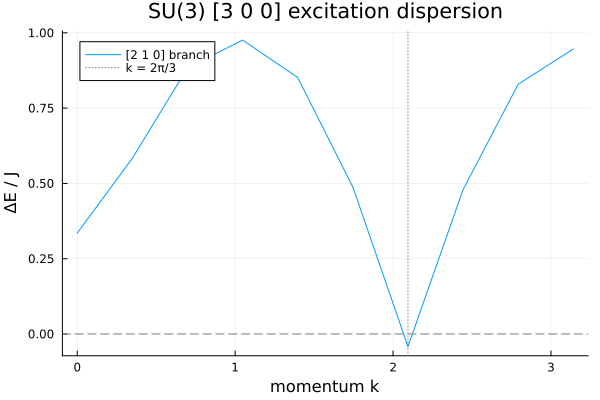
Reproduces the setup of the SU(3) [3 0 0] Heisenberg chain (Devos et al., 2022): the physical site carries the ten-dimensional [3 0 0] irrep, the SU(3)-invariant nearest-neighbour coupling is assembled by hand with SUNRepresentations.jl (MPSKitModels has no built-in SU(N) Heisenberg), the uniform ground state is found with VUMPS, and the [2 1 0]-sector excitation dispersion is scanned across the Brillouin zone. The natural non-abelian counterpart to the spin-1 Haldane gap example, and the only gallery example using an SU(N>2) symmetry. Level: advanced.
Dynamics & finite temperature
DQPT in the Ising model
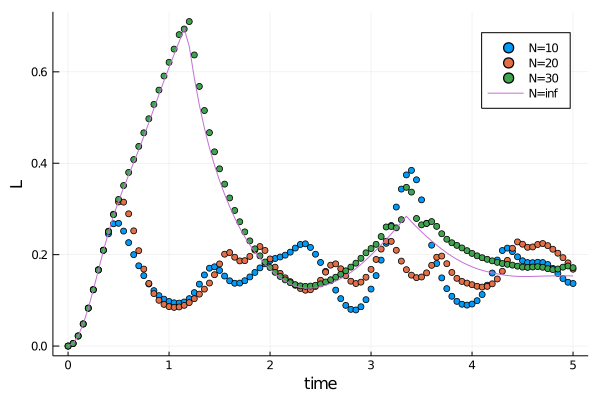
Quenches the transverse-field Ising chain across its critical point and tracks the Loschmidt echo in search of non-analyticities (dynamical quantum phase transitions), on both a finite chain (TDVP2/TDVP) and directly in the thermodynamic limit (changebonds with OptimalExpand, then TDVP). A compact introduction to real-time evolution and environment reuse, still without symmetries. Level: introductory/intermediate.
Finite temperature XY model
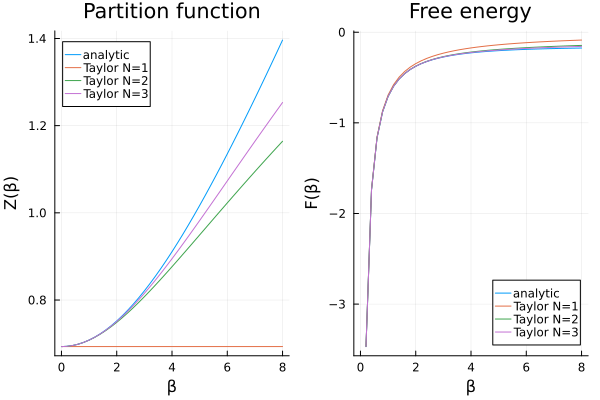
Simulates the finite-temperature XY chain by purifying the infinite-temperature density matrix and evolving it in imaginary time, then compares the resulting partition function and free energy against exact diagonalization and, via BenchmarkFreeFermions.jl, the exact free-fermion solution. A technical, comparison-heavy example built around MPSKit.infinite_temperature_density_matrix and imaginary-time evolution rather than ground-state search. Level: advanced.
Statistical mechanics
The Hard Hexagon model
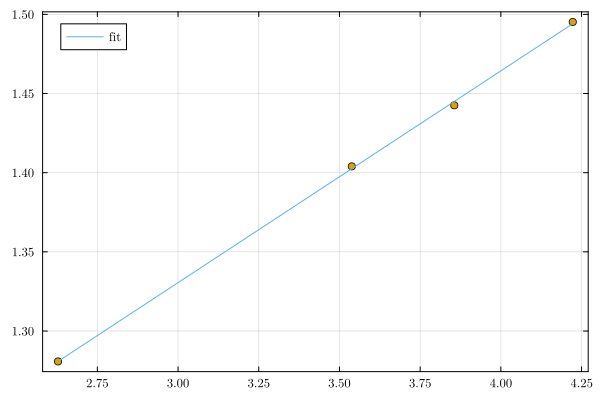
Extracts the central charge of the hard hexagon lattice gas by finding the leading boundary MPS of its transfer matrix with VUMPS (using Fibonacci-anyon virtual spaces), then fitting the CFT-predicted scaling relation between entanglement entropy and correlation length as the bond dimension is increased. The only classical statistical-mechanics example in the gallery, and the only one demonstrating non-abelian anyonic symmetries (FibonacciAnyon) in MPSKit. Level: advanced.